 |
LALApps 10.1.1.1-bf6a62b
|


|
|
LALApps 10.1.1.1-bf6a62b
|
|
Prototypes | |
| int | main (void) |
lal_animate — produces an animated display showing the time series output of a selected channel in a lower window, and a simultaneously calculated FFT power spectrum in the upper window
lal_animate [–help] [–channel name] [–duration secs] [–epoch sec nsec] [–framedir dirname] [–highpass freq attenuation] [–numpts npoints] \(|\) xmgr -pipe
lal_animate produces an animated display showing the time series output of a selected channel in a lower window, and a simultaneously calculated FFT power spectrum in the upper window. The output from this program must be piped into the graphing program xmgr.
–help: Print a help message. –channel name: Name of frame channel –duration secs: How many seconds to look at –epoch sec nsec: Starting epoch –framedir dirname: Directory containing frame files –highpass freq attenuation: High-pass filter parameters –numpts npoints: Points per graph to display To run the program, type:
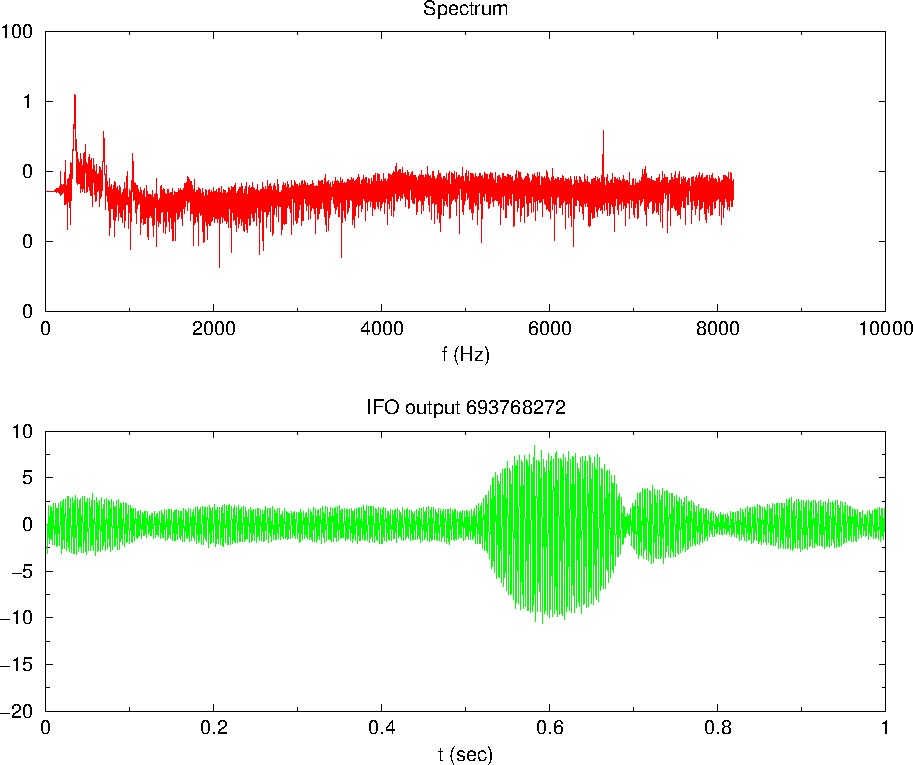
This will search in directory ./h1 for frame files containing the channel H2:LSC-AS_Q and pipe the data starting at 693768272 GPS seconds and 0 GPS nanonseconds to xmgr in segments containing 16384 points until 1 seconds of data has been reviewed. The data is highpass filtered to above 300 Hz with an attenuation of \(0.1\); the output is shown in this figure.
lalapps_animate programDefinition in file animate.c.
Go to the source code of this file.
Macros | |
| #define | TRUE 1 |
| #define | FALSE 0 |
| #define | FRAMEHEARSEEC_ENORM 0 |
| #define | FRAMEHEARSEEC_EARG 2 |
| #define | FRAMEHEARSEEC_MSGENORM "Normal exit" |
| #define | FRAMEHEARSEEC_MSGEARG "Error parsing arguments" |
| #define | USAGE |
| #define USAGE |
 1.9.4
1.9.4